people included in the integrated 2019–2023 analysis
Madrid Positivo · Mobile Screening Unit
Knowledge shaped by practice.
Results, publications and insights from community screening in Madrid.
Results and impact
An evaluated, measurable model focused on outcomes.
The unit's experience has generated evidence on screening, diagnosis and linkage to care in populations facing barriers to access. The largest published analysis brings together interventions carried out between 2019 and 2023.
Read the 2026 studyHIV prevalence in the population analysed
prevalence of active HCV infection
of people with a known HIV diagnosis were not receiving treatment
of people with HCV antibodies did not complete confirmatory RNA testing
people screened
Active HCV fell from 7.2% to 3.4%.
JAMA Network Open ↗participants
Active HCV infection fell from 23.4% to 6.0%.
Eurosurveillance ↗people screened
Active HCV: 3.1%. Treatment was started by 57 of 70 people with a positive RNA result.
Eurosurveillance ↗How to read these data: these are published cohorts with overlapping periods, locations and participants; their figures should not be added together. The figures describe the periods analysed and are not a real-time counter. FOCUS operational results are presented separately in their own section.
Publications and evidence
Street outreach also generates knowledge.
Studies conducted with hospitals, universities, research centres and community organisations assess real-world outcomes, identify inequalities and help design more accessible interventions.
We distinguish studies using mobile unit data or interventions from research by the team and its collaborators.
HIV/HCV prevalence and the retention paradox in marginalized populations in Madrid (2019-2023): A large-scale cross-sectional study.
Estimates HIV and HCV prevalence and risk factors and characterises their care cascades through integrated, low-threshold screening at locations with high levels of vulnerability in Madrid.
Why it matters
Read publication Among 4,582 people, prevalence was 6.3% for HIV and 5.5% for active HCV; 17.0% of people with a known HIV diagnosis were not receiving treatment, and 16.8% of those with HCV antibodies did not complete confirmatory RNA testing.
Prevalence of HCV Infection Among People Experiencing Homelessness in Madrid, Spain.
A 2019-2023 study estimating the prevalence, risk factors and trends in active HCV infection among people experiencing homelessness screened on the streets and in shelters in Madrid.
Why it matters
Read publication Among 2,709 people experiencing homelessness, there were 172 active infections and 148 treatment initiations, while prevalence fell from 7.2% to 3.4% between 2019 and 2023.
Decrease in active hepatitis C infection among people who use drugs in Madrid, Spain, 2017 to 2023: a retrospective study.
Assesses risk factors and trends in active HCV infection between 2017 and 2023 among people who use drugs seen by a mobile screening unit in Madrid.
Why it matters
Read publication Among 2,264 participants, active infection fell from 23.4% to 6.0% overall, from 41.0% to 15.0% among people who injected drugs and from 7.0% to 1.3% among those who did not inject.
Detection of active hepatitis C in a single visit and linkage to care among marginalized people using a mobile unit in Madrid, Spain.
Evaluates a simplified model that diagnoses active HCV infection in a single visit to the mobile unit and accompanies people with positive results to hospital on the same day.
Why it matters
Read publication Of 2,001 participants, 136 had active infection; 134 received their result, 133 obtained an appointment, 126 were seen by a doctor and 105 started treatment.
Prevalence and risk factors of active hepatitis C infection among at-risk migrant populations in Madrid, Spain, 2019 to 2023.
Estimates the prevalence, trends and risk factors for active HCV infection among at-risk migrants screened at social and harm reduction centres in Madrid between 2019 and 2023.
Why it matters
Read publication Among 2,288 migrants, the prevalence of active infection was 3.1%, and 57 of 70 people with a positive RNA result started treatment; current injecting drug use increased the adjusted rate 14.7-fold.
HCV, HIV AND HBV rapid test diagnosis in non-clinical outreach settings can be as accurate as conventional laboratory tests.
Compares rapid HCV, HIV and HBV tests using capillary blood in community settings with conventional laboratory assays in a vulnerable population in Madrid.
Why it matters
Read publication Among 301 participants, the tests achieved 98.8% sensitivity and 100% specificity for HCV and 100% for both measures for HIV; the clinical estimate for HBV was limited by having only four confirmed positive cases.
Three findings
The evidence at a glance.
Our own visualisations based on published data; these are not reproductions of the figures in the articles.
2,709 people screened
Ryan et al., 2024 ↗HIV100%Sensitivity
HIV100%Specificity
HCV98.8%Sensitivity
HCV100%Specificity
Original figures
A look at the published work.
Two figures from open-access articles, reproduced with attribution and without modification.
Communications Medicine, 2023 · Figure 3.
Source · CC BY 4.0 ↗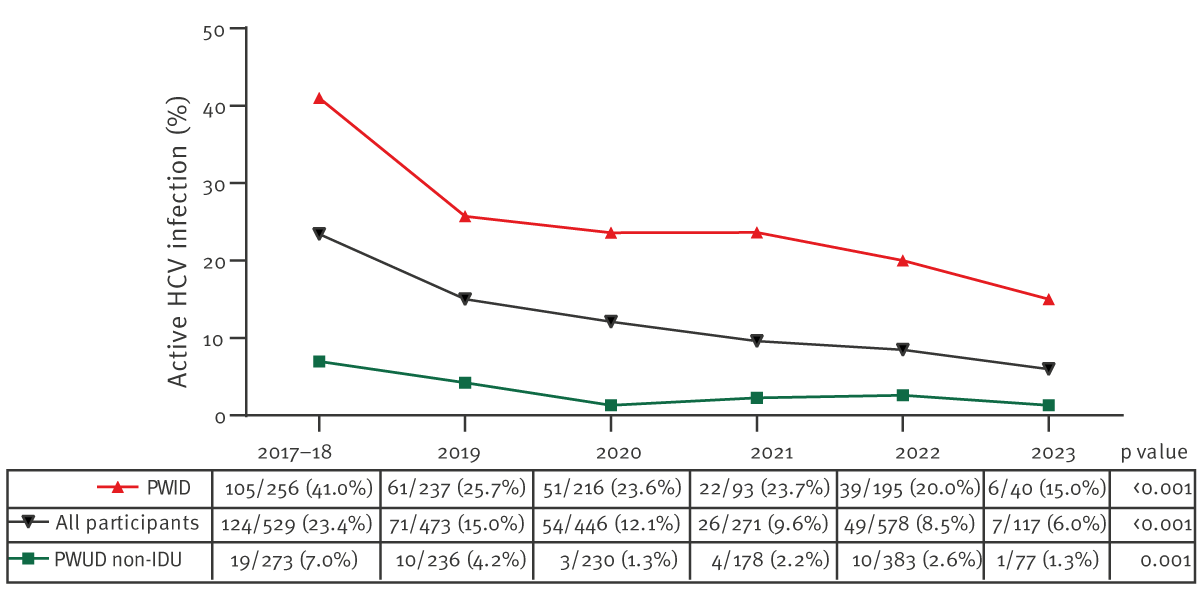
Eurosurveillance, 2024 · Figure 3.
Source · CC BY 4.0 ↗Full catalogue
22 publications
22 publications shown
PrEP discontinuation among sex workers: Gender disparities and the impact of housing instability in a prospective cohort study.International Journal of Infectious Diseases · Team research+
Analyses PrEP discontinuation and its structural and demographic determinants in a diverse cohort of sex workers receiving care at a specialist clinic in Madrid.
Impact: Among 189 participants, the incidence of discontinuation was 9.9 per 100 person-months, reaching 20.8 among cisgender women, and housing instability almost doubled the adjusted risk of discontinuation (aHR 1.91).
HIV/HCV prevalence and the retention paradox in marginalized populations in Madrid (2019-2023): A large-scale cross-sectional study.International Journal of Infectious Diseases · Mobile unit data+
Estimates HIV and HCV prevalence and risk factors and characterises their care cascades through integrated, low-threshold screening at locations with high levels of vulnerability in Madrid.
Impact: Among 4,582 people, prevalence was 6.3% for HIV and 5.5% for active HCV; 17.0% of people with a known HIV diagnosis were not receiving treatment, and 16.8% of those with HCV antibodies did not complete confirmatory RNA testing.
Intensive longitudinal follow-up of cisgender and transgender women engaged in sex work during the three months following initiation of daily oral PrEP: A series of case-studies with mixed-method assessments.PLOS Global Public Health · Team research+
Follows the everyday experiences, adherence, facilitators and barriers over three months among cisgender and transgender women engaged in sex work who started daily oral PrEP in Madrid.
Impact: Fifteen participants contributed 1,266 daily surveys and 13 interviews; mean adherence exceeded 70%, with routines and alarms identified as facilitators, and adverse effects, travel and rigid protocols as barriers.
Prevalence and risk factors of active hepatitis C infection among at-risk migrant populations in Madrid, Spain, 2019 to 2023.Eurosurveillance · Mobile unit data+
Estimates the prevalence, trends and risk factors for active HCV infection among at-risk migrants screened at social and harm reduction centres in Madrid between 2019 and 2023.
Impact: Among 2,288 migrants, the prevalence of active infection was 3.1%, and 57 of 70 people with a positive RNA result started treatment; current injecting drug use increased the adjusted rate 14.7-fold.
HIV-infected Latin American asylum seekers in Madrid, Spain, 2022: A prospective cohort study from a major gateway in Europe.Eurosurveillance · Team research+
Characterises Latin American asylum seekers living with HIV and the barriers they face in continuing treatment and accessing healthcare in Madrid.
Impact: Among 631 participants, 74% faced healthcare barriers and 33% arrived with a detectable viral load; after six months, 99% were taking treatment and 98% had an undetectable viral load.
Decrease in active hepatitis C infection among people who use drugs in Madrid, Spain, 2017 to 2023: a retrospective study.Eurosurveillance · Mobile unit data+
Assesses risk factors and trends in active HCV infection between 2017 and 2023 among people who use drugs seen by a mobile screening unit in Madrid.
Impact: Among 2,264 participants, active infection fell from 23.4% to 6.0% overall, from 41.0% to 15.0% among people who injected drugs and from 7.0% to 1.3% among those who did not inject.
Determinants of Intention to Use HIV Pre-exposure Prophylaxis and Condom Use Among a Sample of Cisgender Female Sex Workers Working Mostly Outdoors in Madrid, Spain.Archives of Sexual Behavior · Team research+
Examines the intention to use PrEP and the determinants of inconsistent condom use among cisgender women engaged in sex work contacted through NGO outreach activities in Madrid.
Impact: Among 102 participants, only 9.8% knew about PrEP, but 72.5% intended to use it, and 25.5% reported inconsistent condom use, indicating a clear gap in information and access.
Prevalence of HCV Infection Among People Experiencing Homelessness in Madrid, Spain.JAMA Network Open · Mobile unit data+
A 2019-2023 study estimating the prevalence, risk factors and trends in active HCV infection among people experiencing homelessness screened on the streets and in shelters in Madrid.
Impact: Among 2,709 people experiencing homelessness, there were 172 active infections and 148 treatment initiations, while prevalence fell from 7.2% to 3.4% between 2019 and 2023.
HCV, HIV AND HBV rapid test diagnosis in non-clinical outreach settings can be as accurate as conventional laboratory tests.Scientific Reports · Mobile unit data+
Compares rapid HCV, HIV and HBV tests using capillary blood in community settings with conventional laboratory assays in a vulnerable population in Madrid.
Impact: Among 301 participants, the tests achieved 98.8% sensitivity and 100% specificity for HCV and 100% for both measures for HIV; the clinical estimate for HBV was limited by having only four confirmed positive cases.
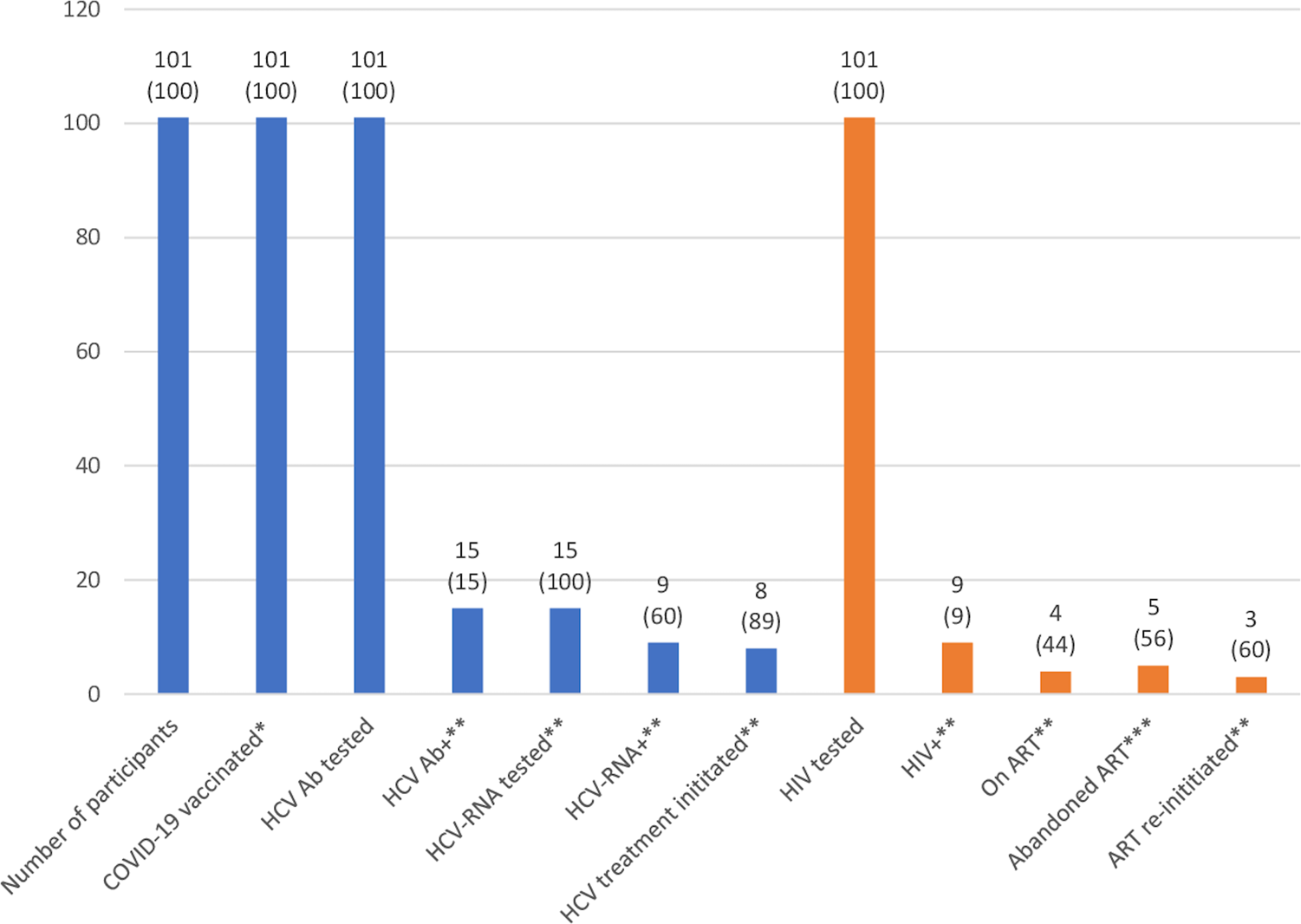
Combined COVID-19 vaccination and hepatitis C virus screening intervention in marginalised populations in Spain.Communications Medicine · Multicentre study+
Evaluates the acceptance of combining COVID-19 vaccination with HCV screening and, in Madrid, HIV screening too, among marginalised populations receiving care in Barcelona and from a mobile unit in Madrid.
Impact: All 101 participants at the Madrid mobile unit accepted vaccination and screening; 9 were HCV RNA-positive and 8 started treatment, while 3 of 5 people with HIV who had discontinued therapy restarted it.
Effectiveness of an HIV care model integrated into addiction care based on medication-assisted treatment for HIV-positive people who use drugs.AIDS Care · Team research+
Evaluates a model of HIV care integrated with addiction care and observed administration of antiretroviral treatment among people who used drugs.
Impact: The model achieved viral suppression of 73% in the intention-to-treat analysis and 92.4% in the modified analysis, associated with opioid substitution treatment and adherence above 90%.
Differences in the hepatitis C virus cascade of care and time to initiation of therapy among vulnerable subpopulations using a mobile unit as point-of-care.Liver International · Mobile unit data+
Analyses differences in the HCV care cascade and time to treatment across several vulnerable subpopulations screened with a mobile unit between 2019 and 2021.
Impact: Of 214 people with active infection, 164 started treatment and 141 completed it; people who injected drugs were less likely to start treatment and, along with those with alcohol use disorder, were less likely to complete treatment.
Recurring Severe Injection-Related Infections in People Who Inject Drugs and the Need for Safe Injection Sites in Madrid, Spain.Open Forum Infectious Diseases · Historical milestone+
Quantifies severe injection-related infections and hospital admissions among people who inject drugs receiving opioid agonist treatment through a mobile service without a supervised consumption room.
Impact: Among 237 participants, 104 severe episodes were recorded in 56 people, an incidence of 26.8 per 100 person-years, and 53.8% of episodes ended in patient-directed discharge.
Reducing Read Time of Point-of-Care Test Does Not Affect Detection of Hepatitis C Virus and Reduces Need for Reflex RNA.Clinical Gastroenterology and Hepatology · Multicentre study+
Investigates whether reading a rapid HCV antibody test at five minutes maintains the ability to identify people with viraemia and speeds up screening.
Impact: The five-minute threshold identified all viraemic cases in the Madrid group of 176 people with antibodies and achieved 100% sensitivity and negative predictive value in the combined cohorts.
HIV screening and retention in care in people who use drugs in Madrid, Spain: a prospective study.Infectious Diseases of Poverty · Related outreach+
Describes HIV screening, retention in care and linkage to HCV care among people who use drugs receiving care in Cañada Real Galiana.
Impact: Of 529 participants, 35 had HIV, and retention fell from 28 people at the end of screening in 2018 to 22 at the end of 2020; of 12 people with active HCV coinfection, only 5 started treatment.
Detection of active hepatitis C in a single visit and linkage to care among marginalized people using a mobile unit in Madrid, Spain.International Journal of Drug Policy · Mobile unit data+
Evaluates a simplified model that diagnoses active HCV infection in a single visit to the mobile unit and accompanies people with positive results to hospital on the same day.
Impact: Of 2,001 participants, 136 had active infection; 134 received their result, 133 obtained an appointment, 126 were seen by a doctor and 105 started treatment.
HCV screening based on dried blood samples and linkage to care in people who use drugs: A prospective study.International Journal of Drug Policy · Mobile unit data+
Evaluates HCV screening using dried blood spots and describes the subsequent care cascade, while also estimating HBV and HDV prevalence, among people who use drugs reached by a mobile unit.
Impact: Of 529 participants, 122 were HCV RNA-positive, but only 62 were assessed in hospital and 56 started treatment, showing that diagnosis worked better than linkage to care.
The Challenging Road to Hepatitis C Virus Eradication.Journal of Clinical Medicine · Team research+
Gender-based vulnerability in women who inject drugs in a harm reduction setting.PLOS ONE · Team research+
Describes violence, abuse and other gender-related vulnerabilities among women who used heroin or cocaine and were seen during infection screening at a harm reduction service in Madrid.
Impact: Of 109 women, 88% reported emotional or psychological harm, 71% serious physical injuries caused by a male partner and 49% sexual abuse, supporting multidisciplinary interventions with a gender perspective.
High rates of early HCV reinfection after DAA treatment in people with recent drug use attended at mobile harm reduction units.International Journal of Drug Policy · Historical milestone+
Measures early HCV reinfection after antiviral treatment among people with recent drug use seen at two low-threshold mobile harm reduction units.
Impact: There were 10 reinfections among 121 people at risk: 9.8 per 100 person-years overall and 18.9 per 100 person-years among those who had injected in the 30 days before treatment.
High HIV seroconversion rate in hepatitis C virus-infected drug users followed in a harm reduction unit: a lost opportunity for preexposure prophylaxis.AIDS · Historical milestone+
Estimates HIV incidence among people who use drugs followed at a harm reduction unit and assesses the need to add PrEP to prevention strategies.
Impact: Ten of 260 participants with follow-up seroconverted: 3.02 cases per 100 person-years overall and 4.98 among those with HCV, whose infection was associated with a 6.43-fold higher adjusted risk.
Evaluation of dried blood spot samples for screening of hepatitis C and human immunodeficiency virus in a real-world setting.Scientific Reports · Related outreach+
Develops and evaluates a method for detecting HCV and HIV from the same capillary dried blood spot sample in real-world practice.
Impact: In 139 samples, HIV serology achieved 100% across all metrics, HCV serology achieved 92.6% sensitivity and 100% specificity, and HCV RNA detection achieved 99.1% sensitivity and 100% specificity.